
(Mon-Sun) 24/7
317-288-5474Talk to us

October 16, 2026

Training staff to spot phishing emails is not enough—four overlooked weak points often expose law firms to greater breach risks than the inbox ever will. Focusing only on email leaves vendor access, mobile devices, physical entry, and old credentials unguarded.
Picture a litigation support specialist who left your firm three weeks ago, except her login still works and nobody has checked. That's the gap this article is really about, and it has nothing to do with phishing training.
Nearly three-quarters (72.2%) of law firms audited showed weaknesses in their cybersecurity defenses, exposing them to risks beyond the usual email threats. So even a firm that feels buttoned up on phishing simulations and spam filters may still be carrying blind spots nobody has walked through in years.
That's the real shape of law firm cybersecurity: it was never just about the inbox. Plenty of firms pour budget into staff email training, and attackers, knowing that, simply route around it.
Protecting sensitive legal data takes a wider lens than watching who clicks what. Stop at email, and you may be guarding the one door everyone already locks while three others sit open.

Many law firms in Indiana and elsewhere run regular email security training, and that's a reasonable starting point. But attackers know inboxes get watched closely, so they go looking for the doors nobody's standing in front of.
Those doors tend to be the parts of the business nobody reviews on a daily rhythm: the vendors and systems plugged into your network, the phones and tablets staff carry home, even the physical entrance to the office itself.
Spend all your attention on email, and these other doors stay wide open the whole time. That's the case for looking at the full perimeter rather than the one piece everyone already remembers to check.
Most firms work hard on email defenses, and that effort is well placed, but it also means attackers have simply moved on to less obvious ground. Four spots in particular deserve the same attention the inbox already gets.
Outside vendors - IT contractors, document management providers, whoever else touches the network - often carry real permissions into your systems, and if one of them is compromised, that access travels with the breach.
Trust is the whole relationship with a vendor, and without strict controls around what that trust actually permits, it turns into the weakness itself.
Lawyers and staff check email, pull up documents, and message clients from phones and tablets that leave the building every evening, which means those devices can just as easily be lost, stolen, or quietly infected.
A phone without a strong passcode and encryption on it isn't just a lost phone - it's potentially a lost case, or worse, a breach with a client's name attached to it.
Physical access rarely makes it onto a cybersecurity checklist, and yet anyone who walks into your office unchallenged can walk out with a laptop or plug in hardware that opens a door from the inside.
Entry systems and visitor logs sound almost too basic to matter, but they're often the one control standing between a stranger in the hallway and a breach that started with nothing more technical than an unlocked door.
When someone leaves, their access needs to come down immediately, and if an old account stays live, a former employee - or anyone who finds that login - can walk through it without tripping a single alarm.
A clear offboarding checklist closes that gap the day it opens instead of months later.
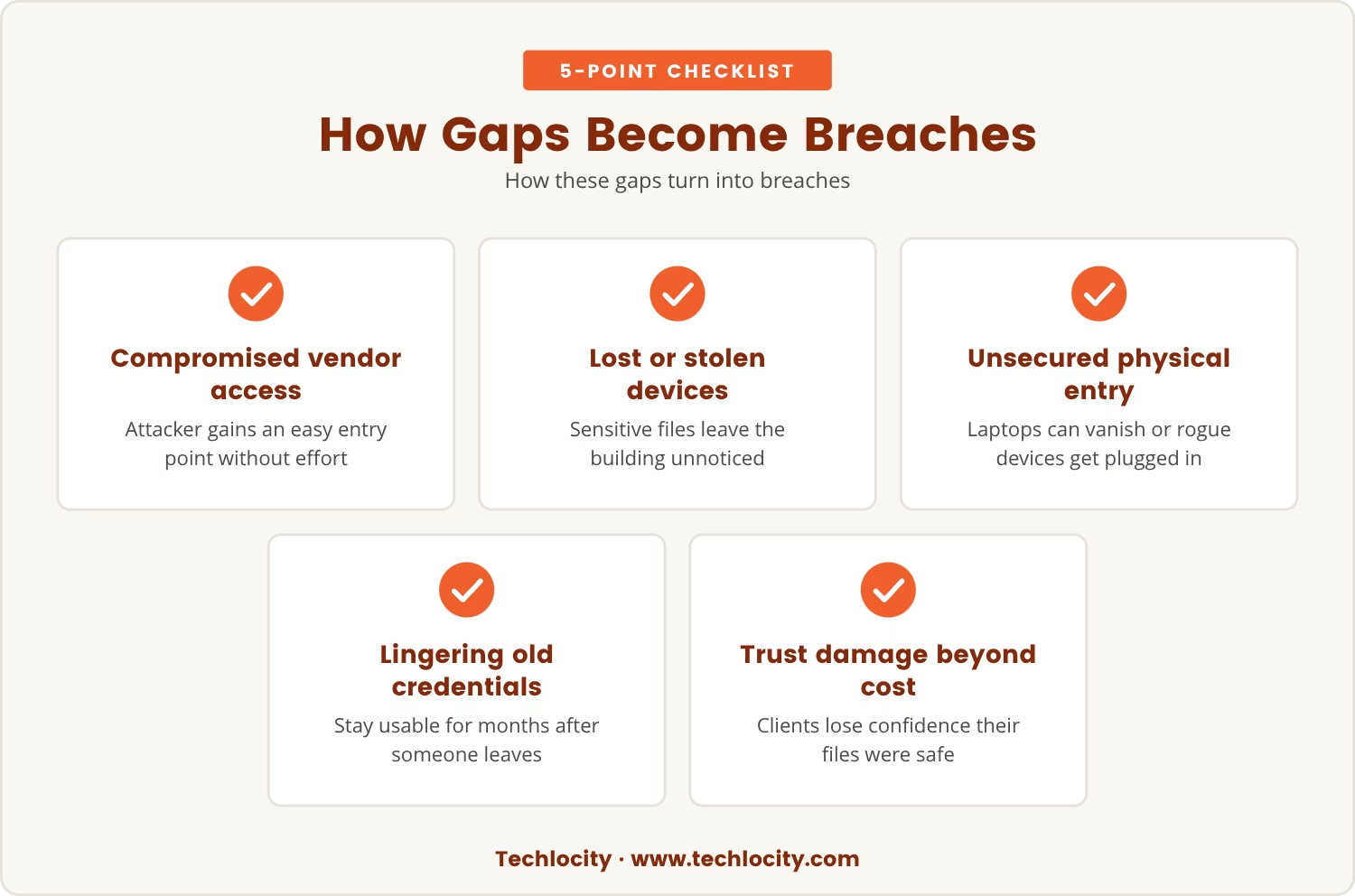
Each of these weak points carries its own mechanism. A compromised vendor hands an attacker a door they didn't have to pick themselves. A lost or stolen device walks sensitive files out of the building in someone's pocket.
Unsecured physical entry lets a laptop disappear or a rogue device get plugged straight into the network. And credentials left active after someone departs can sit there, usable, for months before anyone notices.
None of this is hypothetical risk in the abstract - it's the mechanical path real breaches at firms of every size tend to follow, because attackers go looking for whichever door is easiest, and the inbox is rarely it anymore.
Ignore these areas long enough, and the cost isn't just financial. It shows up as damaged trust with the clients who assumed their files were safer than that.
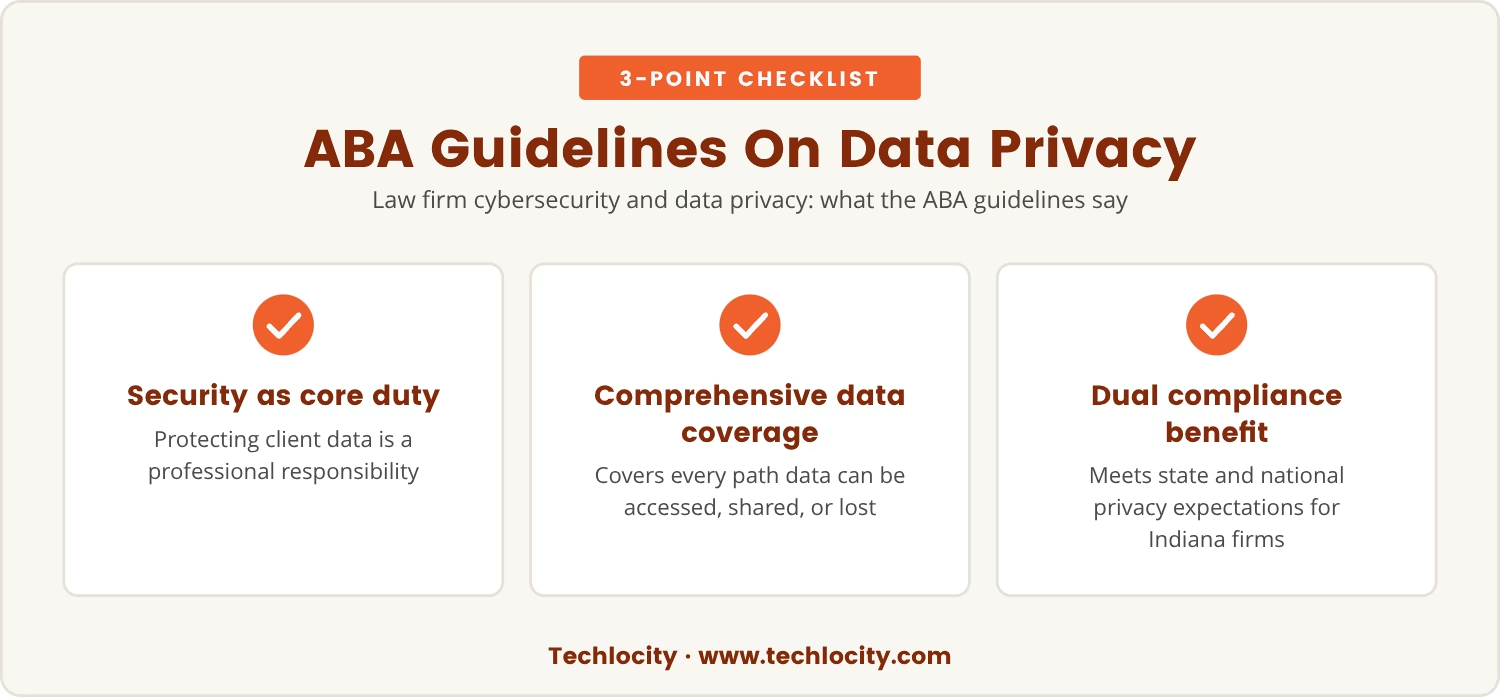
The ABA cybersecurity guidelines treat protecting client data as a core professional responsibility, not an optional add-on, and that framing matters because it turns security into a trust question rather than a technical one.
The guidelines call for a comprehensive approach to data privacy - every path data can be accessed, shared, or lost, not just the one path everyone already watches.
For firms in Indiana, following that guidance does double duty: it satisfies both state and national expectations around privacy law, and it means you're not scrambling to answer a client's security questions after the fact.
None of this requires a sweeping overhaul - just a handful of concrete, ongoing actions, each one closing a specific door rather than guarding the one everyone's already watching.
Each step narrows the ground an attacker has to work with, and over a year or two, that steady narrowing is what actually moves the needle on overall exposure.
Email-only security leaves a firm exposed to the threats that don't announce themselves the way a phishing email does, and a single breach traced back to a forgotten device or a stale account tends to cost far more than the hour it would have taken to close that gap.
Law firm cybersecurity was never only about compliance checkboxes - it's about protecting clients, reputation, and the business itself, and that protection only holds up once you've looked past the inbox at everything else connected to it.
Firms in Indiana face the same threat landscape as firms anywhere else, even where local regulation and client expectations shape the details differently, and treating security as one piece of a bigger plan rather than a bolt-on is what keeps a firm both compliant and competitive at the same time.
Our instinct here - and we keep checking it against how these engagements actually play out - is that strategy, security and support hold together better as one price than as three line items a client can unbundle. We're glad to tailor the specifics to a firm's systems and headcount, but a client who only wants the baseline tier isn't really a fit for us.
That's not any kind of pressure play, just a recognition that the quarterly review, the twice-yearly scorecard, and the roadmap conversation only talk to each other when they're part of the same engagement instead of three separate vendors handling three separate pieces.
Split those pieces apart, and nobody owns the seam between them - which is exactly the kind of gap the rest of this piece has been describing.
Clients want to know their data is safe no matter how it's stored or reached, and showing that takes the same complete view - vendor access, devices, doors, offboarding - applied as one consistent practice rather than handled in pieces.
Have you reviewed your own offboarding process, or checked which vendors still hold access to your systems? Those two questions alone tend to surface a gap before anyone has to find it the hard way.

Many law firms with 25 to 150 employees focus on email security but may not realize how much risk remains in other areas. At Techlocity, we understand how easy it is to overlook these hidden entry points.
We invite you to see how our team approaches law firm security as a complete system, not just an inbox problem. Let’s talk about your setup and how you can close the gaps others miss.
Try our services risk-free for 90 days and see how your law firm’s security can improve with a complete approach.
Review and limit that vendor's permissions right away, disable anything not strictly necessary, change passwords, and watch your network for unusual activity. Notify any clients whose data may have been exposed, and fold vendor-related risk into your incident response plan going forward.
Require strong passwords and encryption on every device that touches work email or files, and consider mobile device management tools that enforce those settings and allow a remote wipe if a device goes missing. Staff should also avoid unsecured public Wi-Fi for work tasks and keep devices updated.
Unauthorized entry to your office gives someone a direct path to steal equipment or plug in malicious hardware, which turns a physical lapse into a digital breach in short order. Entry systems and visitor logs are simple enough to feel like an afterthought, but they protect both the physical and digital sides of the business at once.
Build an offboarding checklist that disables every account, collects devices, and strips access to sensitive files, and act on it the same day someone leaves rather than sometime after. Regular audits of active accounts catch anything the checklist missed.
At minimum once a year, and again any time you add new systems, vendors, or staff. Regular reviews catch new risk before it sits unnoticed, and they work best when IT staff and firm leadership go through the assessment together.

